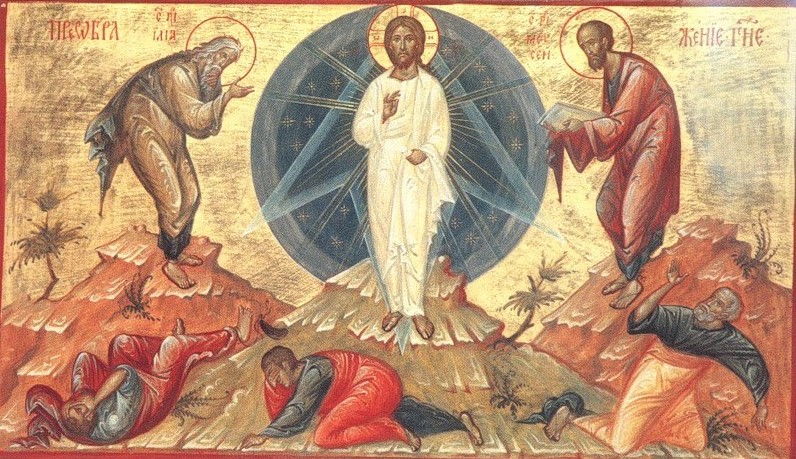
After the Feast of the Transfiguration of Our Lord Jesus Christ
In the name of the Father, and of the Son, and of the Holy Spirit.
Dear brothers and sisters in Christ,
A few days ago, we celebrated the great feast of the Transfiguration of our Lord Jesus Christ.
On Mount Tabor, before Peter, James, and John, the Lord was transfigured: His face shone like the sun, and His garments became white as light. For a moment, the Apostles were permitted to behold the divine glory of Christ, hidden beneath His human appearance.
But the Transfiguration reveals to us not only the mystery of Christ. It also reveals the mystery of our own human calling. We are not created merely for this earthly life. We are called to be transformed by the grace of God and to participate in the light and glory of His Kingdom.
And this is why today’s Gospel, the Gospel of the rich young man, speaks to us with particular depth.
A young man approaches Christ and asks:
“Teacher, what good deed must I do to have eternal life?”
It is a beautiful question. He does not ask about earthly success, wealth, power, or pleasure. He asks about what is most important — eternal life.
The Lord reminds him of the commandments. And the young man answers:
“All these I have kept from my youth. What do I still lack?”
Here we reach the heart of the Gospel.
This is not an evil man who consciously rejects God. On the contrary, he is a moral and religious man who observes the commandments. And yet, deep within himself, he feels that something is still missing.
Then Christ says to him:
“If you would be perfect, go, sell what you possess and give to the poor, and you will have treasure in heaven; and come, follow Me.”
And the Gospel tells us:
“When the young man heard this, he went away sorrowful, for he had great possessions.”
Notice that Christ does not say that wealth itself is a sin. The problem is deeper.
The real question is:
Who possesses the heart of man?
The young man possessed many things. But in the end, we discover that his possessions possessed him.
He desired eternal life, but he was not ready to leave behind what prevented him from following Christ.
And here the Gospel of today is profoundly connected with the Feast of the Transfiguration.
On Mount Tabor, the Apostles saw the light of Christ and heard the voice of the Father:
“This is My beloved Son… listen to Him.”
But listening to Christ means more than simply contemplating His glory.
It means following Him.
Peter, James, and John came down from the mountain together with Christ. The light of Tabor was to become a source of strength for the journey that lay before them — the journey toward Jerusalem, toward the Cross, and then toward the Resurrection.
The rich young man also encountered Christ. But he could not take the next step. He could not leave behind what held him back, and he could not follow the Lord.
And therefore today’s Gospel puts a very personal question before each one of us:
What prevents me from following Christ?
Perhaps it is not money or material wealth.
It may be self-love, pride, the desire always to be right, an attachment, a habit, a fear, ambition, or an excessive attachment to another person or to something earthly.
Each of us has something that can gradually become our own “wealth” — something that we begin to love more than God.
That is why Christ does not say only:
“Keep the commandments.”
He says:
“Come, follow Me.”
Christianity is not merely morality, nor is it simply the observance of a set of rules.
Christianity is above all a living encounter with Christ and a life of following Him.
We can do many good things and yet fail to give our heart to God.
We can appear religious on the outside while remaining inwardly imprisoned by our own “self.”
Therefore, Christ’s call to the young man is also a call to freedom.
The Lord wants to free us from everything that prevents us from truly loving.
For Christian perfection does not consist in possessing everything, but in being enslaved by nothing except God.
When the disciples heard Christ’s words about wealth, they were astonished and asked:
“Who then can be saved?”
And the Lord answered:
“With man this is impossible, but with God all things are possible.”
These words contain the great hope of the Christian.
Salvation is not a human achievement.
We are not saved because we have managed to become good enough.
Christ is the One who saves us.
But He calls us to open our hearts to Him and to follow Him.
Therefore, brothers and sisters, after contemplating the light of Tabor, we must not remain merely spectators of that light.
We must ask ourselves:
What needs to change in me so that the light of Christ may truly enter my life?
The Transfiguration is not merely an event that happened long ago on Mount Tabor. It reveals what God desires to accomplish in each one of us: to transform our lives by His grace.
But for this, we must hear Christ’s call:
“Come, follow Me.”
For one person, this may mean renouncing a particular passion.
For another, learning to forgive.
For another, becoming humble.
For another, returning to a life of prayer.
And for someone else, it may mean freeing oneself from an attachment that has become so strong that it has taken in the heart the place that belongs to God alone.
Then we understand that Christ’s words to the rich young man are not only about wealth.
They are above all about the human heart.
What is my treasure?
Where is my heart?
And finally:
Who truly is the Lord of my life?
Let us ask Christ not only to show us His light, but also to give us the strength to walk in that light.
And whenever we feel that this is impossible, let us remember the words of the Lord:
“With man this is impossible, but with God all things are possible.” Amin!
Hiermomonk Joseph (Pavlinciuc)

