Beloved brothers and sisters,
Today’s Gospel places before us one of the most powerful and serious parables spoken by the Saviour – the parable of the wicked tenants.
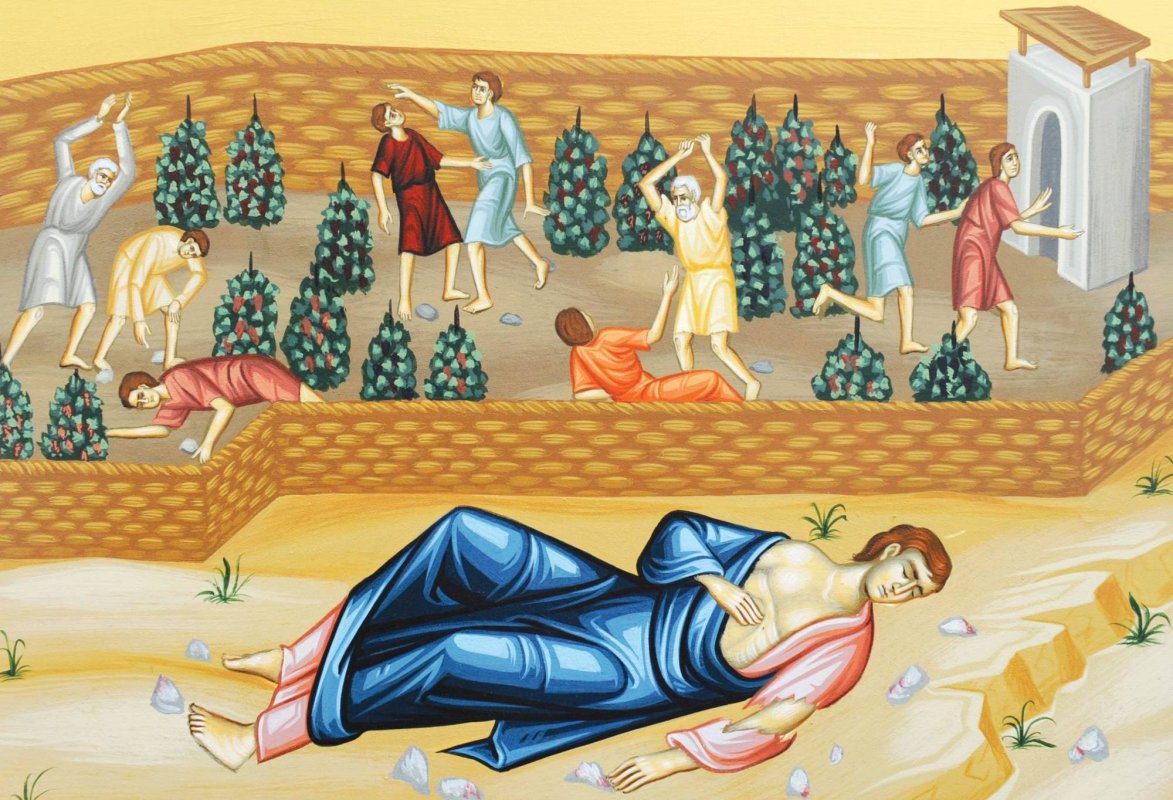
A rich man plants a vineyard, fences it, prepares everything necessary, and entrusts it to tenants. Then he goes away. When the time of fruit comes, he sends his servants to receive what is due to him. But the tenants beat them, kill one, and stone another. Finally, the master sends his own son, saying, “They will respect my son.” But they kill him too.
This is, of course, a parable about the chosen people, about the prophets, and ultimately about the Son of God, who comes into the world and is rejected and crucified. But it speaks not only of the past. It speaks also of us.
For the vineyard is the world that God has entrusted to us, and we are its workers.
Everything we have is, in the final analysis, received: life, time, freedom, gifts, the people God places beside us, the Church, faith. God gives us all these not for us to regard them as our absolute property, but to bear fruit.
And here lies the essential question of the Gospel:
What fruit do we bring to God?
For it is possible to live in a “vineyard” that does not belong to us and yet behave as if we were its masters. It is possible to receive life as a gift and forget the Giver. To receive freedom and turn it into autonomy from God. To receive faith and reduce it to habit. To receive love and respond with indifference.
The wicked tenants in the Gospel did not receive an uncared‑for vineyard; the master had done everything for it. The problem was not God’s gift, but man’s response to the gift.
“His Son”
The climax of the parable is the coming of the son.
“Finally, he sent his son to them, saying, ‘They will respect my son.’”
Here we see the great mystery of God’s love.
God does not give up on man even when man rejects Him. He sends prophets, sends His word, calls to repentance, and finally He sends His own Son.
But we know what the world does to the Son: they cast him “out of the vineyard” and crucify him.
However, what men consider defeat becomes, in God’s plan, the beginning of salvation:
“The stone that the builders rejected has become the cornerstone.”
The Cross is not God’s failure. The Cross is the victory of God’s love over sin and death.
The Mother of God – the opposite response to the wicked tenants
And precisely here, in the days after the feast of the Dormition of the Mother of God, we can see an extraordinary contrast.
The tenants in the Gospel say, in essence, “We do not want the vineyard to belong to the Master. Let it be ours.”
The Mother of God says exactly the opposite.
Her entire life can be summed up in the words:
“Behold, the handmaid of the Lord; be it unto me according to your word.”
She does not turn God’s gift into her own property. She does not say, “My life is mine.” Rather, she receives it as a gift and returns it to God.
Therefore, in the Mother of God we see the man who bears fruit.
The fruit of her life is obedience.
Her fruit is humility.
Her fruit is purity of heart.
Her fruit is faith.
Her fruit is love.
And, above all, her fruit is Christ Himself.
If the parable asks us, “What have you done with the vineyard that God entrusted to you?”, the Mother of God shows us the answer.
“Watch, stand firm in the faith”
Today’s Apostle beautifully completes this teaching. Saint Paul says:
“Watch, stand firm in the faith, be courageous, be strong. Let all that you do be done in love.”
Notice how concrete this word is.
It is not enough to say, “I believe in God.”
Faith must produce fruit.
“Watch” – that is, do not live without heed, as if life were only yours.
“Stand firm in the faith” – because there will be temptations, doubts, sufferings, and moments when we will be tempted to drive God out of the “vineyard” of our lives.
“Be courageous, be strong” – because the Christian life requires patience and steadfastness.
And then: “Let all that you do be done in love.”
This is perhaps the simplest definition of a life that bears fruit.
What do we do with the Lord’s vineyard?
Brothers and sisters,
perhaps the question of this Sunday is not, “Am I a believing person?”
But a much deeper one:
“What fruit does my faith produce?”
If God has given me a family, what fruit do I bring in my family?
If He has given me people around me, what fruit do I bring in my relationships with them?
If He has given me freedom, do I use it for good or for selfishness?
If He has given me time, how do I use it?
If He has given me faith, is it seen in my life?
If He has given me the ability to forgive, do I forgive?
If He has given me the strength to love, do I love?
For at the end of life, God will not ask us only what we have received, but also what we have done with what we received.
Our lives are His vineyards.
The Dormition of the Mother of God and the fruit of a life
That is why it is so fitting to hear this Gospel after the Dormition of the Mother of God.
In the Mother of God we see that the true fruitfulness of life does not mean having as much as possible, being as powerful as possible, or being recognized by people.
It means being able to say, at the end of life:
“Lord, what You gave me, I entrust to You.”
Her Dormition is not a tragic separation, but the passage to the fullness of life with God. That is why the Church calls her “more honourable than the Cherubim, and beyond compare more glorious than the Seraphim.”
She shows us that man finds his fulfilment not when he appropriates everything, but when he gives himself to God.
And this too is the mystery of today’s Gospel:
Life becomes fruitful when we cease to consider ourselves its masters and acknowledge ourselves as workers in God’s vineyard.
Let us therefore ask the Mother of God to help us not to be workers who keep the fruits only for themselves, but people who know how to return to God what they have received from Him.
And when God comes to seek the fruits of our vineyard, may He find in us what Saint Paul asks of us today:
steadfast faith, a strengthened heart, and, above all, love.
Amen.
